Autonomía digital y tecnológica

Código e ideas para una internet distribuida

Linkoteca. Archivo de navegación


El mensaje del mercado: la IA es casi mágica, automatiza y escala. Pon la herramienta y olvídate.

Pero la ley dice lo contrario. El artículo 14 del AI Act exige supervisión por personas que entiendan las limitaciones del sistema, reconozcan el sesgo de automatización y puedan ignorar o parar el sistema cuando haga falta. El regulador sabe que la gente aprieta «aceptar» sin leer.

Y hay una trampa: si adaptas un modelo genérico para usos de alto riesgo ( contratación, evaluación, crédito) pasas a ser proveedor automáticamente. No existe el vacío de «la culpa es de la máquina». Ellos lo dejan claro con frases como esta («Claude es IA y puede cometer errores. Por favor, verifica las respuestas.»)

La paradoja de fondo: cuanto más automatizas, más se erosiona la capacidad del operador para supervisar con criterio real. El marketing dice «casi mágica». La ley dice «necesitas personas competentes». Las dos cosas no caben en la misma frase. Dicho de otra manera cuando el coche autónomo falla te dicen que pilles el volante.

La aceleración y la regulación van en direcciones opuestas. La pregunta no es si la IA funciona. La pregunta es si la persona que firma lo que la IA produce sabe lo que está firmando.

Porque cuando falle, la responsabilidad no caerá sobre el modelo. Caerá sobre quien lo desplegó sin entenderlo.

React Router is a multi-strategy router for React. There are three primary ways, or «modes», to use it in your app. Across the docs you’ll see these icons indicating which mode the content is relevant to:

Framework
Data
Declarative

The features available in each mode are additive, so moving from Declarative to Data to Framework simply adds more features at the cost of architectural control. So pick your mode based on how much control or how much help you want from React Router.

Why Headless UI Libraries matter in modern React?

Modern frontend development has shifted heavily toward custom design systems. Teams no longer want off-the-shelf UI kits that dictate colors, spacing, and layout. Instead, they want full control over styling while still getting:

Accessibility done right
Predictable behavior
Cross-browser consistency
Composable APIs

This is where headless UI libraries come in.

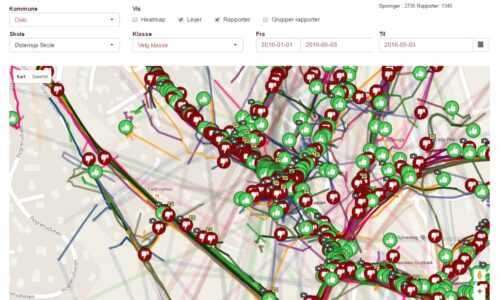
Captura de pantalla de la aplicación Secret Agents de Oslo

A new Oslo-based app has taken that idea further and is giving power directly to the people who, when it comes to urban planning, are too-often left out of the conversation: children.

Two years ago, Vibeke Rørholt, who has worked in traffic safety in Norway for more than15 years, began compiling a report that looked into road safety for children in Oslo. Commissioned to work for Norway’s Agency of the Urban Environment, Rørholt had to come up with a way to encourage the capital’s 44,000 children to walk or cycle to school. What better way to find out how they feel about their own security than by asking them directly?

With €347,000 (£290,000) in funding from the city, the Research Council of Norway and consultancy Capgemini, Rørholt needed to find ways to create an environment where parents would feel that it was safe enough for children to walk to school. “I was supposed to make a traffic report on all roads in Oslo. That’s a big job,” she comments. “So I thought, why don’t we ask the children how they feel on the street?” The best way to do that, she says, was to turn to gamification. Using a smartphone app, with the idea of users being “secret agents” for the city, children can send immediate reports on their route to school when they come across, for example, a difficult crossing on the street or an area of heavy traffic. Their location is tracked using GPS, so researchers can pinpoint exactly where these hazards are.

The idea of crowdsourcing information to understand what needs to be improved in cities is nothing new. In Jakarta, Indonesia, the city started exploring how citizens could help address major issues including flooding and congestion. The Emergency Management Agency set up a project called PetaJakarta to create a real-time, crowdsourced map of flooding in the city. In San Jose, California, city authorities have set up what they describe as a “real-time civic engagement tool” whereby residents download a free app, and can send, for example, a photograph of litter connected to GPS that goes directly to city hall.

Rørholt says that using information provided by children through the app, authorities have rebuilt several big crossings and made more pavements to make it safer for pedestrians in the past year. For example, several students reported that they liked to walk through privately-owned land on part of their journey to school as it felt safer, so Oslo municipality agreed with the owner of the property that if the government created a crossing, path and handrail, he would maintain it.

Sin ánimo de polemizar con personas afectadas por la precariedad y los bajos salarios del sector, y por tanto razonablemente cabreadas, venía aquí a hacer una puntualización obvia: cuando pagas a une influencer, o creadore de contenidos o cómo quieras llamarle, no le estás pagando solo el trabajo que le lleve tu encargo. Le estás comprando la audiencia. Una audiencia que le cuesta mucho tiempo no remunerado construir y mantener. No estoy defendiendo las cifras astronómicas absurdas de las súper estrellas de plástico. Pero sí me parece lógico que las personas jóvenes y ‘cool’ que vemos brillar en redes aspiren a cobrar precios en orden de miles, incluso si se trata de una campaña social (no de cientos, como algunas ONG intentan pagar). Si hacéis el cálculo de todo lo que trabajan ‘gratis’ para llegar a una audiencia que tu organización no consigue alcanzar ni de lejos, no, no están cobrando nada caro; puede que sean tu estrategia más eficiente (en relación alcance/precio). De hecho, quitando las súper estrellas que son un porcentaje muy pequeño, les creadores de contenido son el eslabón más débil de la comunicación digital. Lo son porque en realidad trabajan para señores feudales que les cambian las reglas o les cierran el grifo cuando les da la gana, así que todo lo que sea mejorarles las condiciones es de justicia (social).

El rendimiento de los modelos abiertos más avanzados va entre uno y dos años por detrás de los así llamados modelos frontera.

Lo que llamamos modelos abiertos son modelos cerrados a todos los efectos pero para los cuales los pesos (esto es, los coeficientes de ajuste para cada variable que te permite ajustar la inferencia) son públicos y configurables.

En el mundo del software libre nos hemos acostumbrado a que abierto y libre signifiquen lo mismo en la práctica. No es así con estos modelos. No son libres. No puedes crearlos en casa, entrenarlos de nuevo a partir de un puñado de código porque no tienes los datasets para entrenarlos.

a brecha de supervisión que se genera cuando la ejecución de tareas escala con automatización pero la validación humana no escala está haciendo muy costosa la labor de mantenimiento de los proyectos libres. Mucha contribución con código generado por IA pero que a los maintainers del repositorio les lleva mucho tiempo revisar. Como consecuencia, cada vez más proyectos libres anuncian que de alguna forma limitan la contribución, la pone bajo moderación.

Esto destruye la principal ventaja de estos proyectos libres: que ahí afuera hay mucha más masa gris disponible y capaz de contribuir a proyectos libres, lo que les permite ir por delante de alternativas comerciales diseñadas a puerta cerrada, sin importar lo talentoso de ese equipo que trabaja a puerta cerrada.

Two key directives enforce accessibility standards in the EU:

  1. Directive (EU) 2016/2102The Web Accessibility Directive
  2. Directive (EU) 2019/882The European Accessibility Act
    • Extends requirements to many private sector services/products.
    • Mandatory compliance with WCAG 2.1 AA and EN 301 549 as of 28 June 2025.
    • Full text of Directive 2019/882

The guide covers two key considerations:

Data ownership
Data licensing

For those who wish to share data with OpenAQ, the guide outlines the steps to follow both before and after equipment procurement.

OpenAQ and many air quality funders believe in the power of open air quality data to accelerate progress toward a clean air future. No matter whether, when, or with whom you might wish to share data, the important thing is to be informed before you buy!

People increasingly consult generative artificial intelligence (AI) while reasoning. As AI becomes embedded in daily thought, what becomes of human judgment? We introduce Tri-System Theory, extending dual-process accounts of reasoning by positing System 3: artificial cognition that operates outside the brain. System 3 can supplement or supplant internal processes, introducing novel cognitive pathways. A key prediction of the theory is «cognitive surrender»-adopting AI outputs with minimal scrutiny, overriding intuition (System 1) and deliberation (System 2). Across three preregistered experiments using an adapted Cognitive Reflection Test (N = 1,372; 9,593 trials), we randomized AI accuracy via hidden seed prompts. Participants chose to consult an AI assistant on a majority of trials (>50%). Relative to baseline (no System 3 access), accuracy significantly rose when AI was accurate and fell when it erred (+25/-15 percentage points; Study 1), the behavioral signature of cognitive surrender (AI-Accurate vs. AI-Faulty contrast; Cohen’s h = 0.81). Engaging System 3 also increased confidence, even following errors. Time pressure (Study 2) and per-item incentives and feedback (Study 3) shifted baseline performance but did not eliminate this pattern: when accurate, AI buffered time-pressure costs and amplified incentive gains; when faulty, it consistently reduced accuracy regardless of situational moderators. Across studies, participants with higher trust in AI and lower need for cognition and fluid intelligence showed greater surrender to System 3. Tri-System Theory thus characterizes a triadic cognitive ecology, revealing how System 3 reframes human reasoning and may reshape autonomy and accountability in the age of AI.

Breogán Torres nació en Vigo en 1999 y acaba de terminar el bachillerato en el IES Politécnico de la localidad gallega. Jovencísimo fan de Los Enemigos, empezó a indagar sobre el protagonista de aquella portentosa canción. Descubrió que era músico y que su historia apenas se conocía. El pasado invierno, como proyecto final de la asignatura de Audiovisuales, propuso hacer un documental sobre él.

Sin presupuesto, con medios escasos, se plantó en Algeciras junto a sus compañeras Noa Costas y Lara García para rodarlo en tiempo record. Búsquenlo en YouTube, porque está muy chulo.

Les pusieron un 10, pero da la impresión de que eso es lo de menos. “Salimos los tres con la sensación de meternos en la historia de alguien que murió antes de que nosotros naciéramos”, afirma Torres. “Hemos aprendido mucho sobre él, su personalidad, su obra inédita, y eso nos hace sentirnos vinculados a la familia y a la ciudad. Ya lo valorábamos, pero conocer los detalles te hace ver todo muy distinto. ¡Y el aprecio que se le tiene en Algeciras!”.

El nuevo paradigma del desarrollo se llama harness engineering. La pregunta incómoda no es si nos hará más productivos, sino si nos dejará seguir pensando.

Hace dos semanas escribí sobre rendición cognitiva: el efecto que aparece cuando aceptamos sin filtrar lo que la IA nos devuelve. No la evaluamos mal, directamente no la evaluamos. Si va a estar en todas partes, ¿podemos diseñarla para que sigamos pensando, en lugar de para que dejemos de hacerlo?

El sector ya no es el del desarrollador que escribe código, sino el del que monta y opera sistemas agénticos. Lo llamamos harness engineering: construir el arnés alrededor del modelo (evals, observabilidad, prompts, herramientas) para que lo indeterminista se comporte fiablemente.

Cubierta de Yojimbot 1 : Silence metallique

Japon, 2241. Suite à la « 3e crise de l’homme », la surface de la Terre est devenue inhabitable pour l’être humain. Parmi les ruines, ne restent que des robots.
Mais l’un d’eux (un Yojimbot, robot samouraï) tombe inopinément sur Hiro, un jeune garçon, et son père qui cherchent à échapper à une troupe armée. Le Yojimbot se défait de l’escouade et sauve l’enfant. Il va vite comprendre que, de la survie d’Hiro, dépend le sort de l’humanité…

Durante dos décadas, las empresas aprendieron que la visibilidad dependía de ser legibles para los motores de búsqueda. Lo que emerge ahora es más exigente. Ya no basta con ser indexable. Hay que ser utilizable.

Eso no convierte a llms.txt en un truco mágico de posicionamiento. No lo es. Es más bien higiene digital para un mundo en el que cada vez más descubrimiento, resumen y recomendación están mediadas por sistemas de inteligencia artificial. El objetivo no es engañar a un algoritmo. Es reducir la confusión de las máquinas. Y esa diferencia es clave.

Muchas empresas siguen tratando la inteligencia artificial como una capa adicional sobre la web: un chatbot en atención al cliente, algo de contenido generado en marketing, un asistente en la app. Esa visión es superficial.

La web original conectaba documentos. La web de plataformas conectó usuarios y servicios. La siguiente conectará agentes, herramientas, comercios, sistemas de pago e identidades verificadas. Y cuando eso ocurre, la pregunta estratégica cambia: ya no es solo «¿cómo llevo usuarios a mi web?» Pasa a ser «¿cómo hago que mi empresa sea comprensible, fiable y accionable para los sistemas que cada vez se interponen entre yo y mis clientes?»

If you’re reading this, odds are you’re a big music fan. Maybe, at some point, you’ve been called “obsessive” or “encyclopedic” about certain bands. Maybe the act of you explaining the nuances of an album has been described as “pedantic”—or maybe I’m projecting. But what I expect we do share is a common understanding of how we evolved from someone who casually has music on in the background to someone willing to explain to the gas‑station attendant how many vocal mics were used while Bowie was recording “Heroes” because it happens to be playing from someone’s car outside.

The WordPress Transients API is a portion of the WordPress codebase that allows plugin and theme developers to store cached data. This data will eventually expire, after which it’s automatically deleted. Transients are often used to cache data from external API requests that might introduce latency, or from slow-running database queries in which running the query against the actual database on every page load would decrease the site’s performance.

When you save data into a transient, the data is saved into the wp_options table of the WordPress database. At first glance, this makes the Transients API seem similar to the Options API. The main difference is that each transient is given an expiration, after which it will automatically be removed from the database. This is not the case when saving an option in WordPress.

You need to «tell» WP that your script has a translation, and specify which text domain (ID) should be used for this translation. This is done using the wp_set_script_translations() function.

So, the registration of your script with translation should look like this:

wp_register_script( ‘my-handle’, plugins_url( ‘/js/my-file.js’, __FILE__ ) );
wp_set_script_translations( ‘my-handle’, ‘my-domain’ );

The wp_set_script_translations() function adds a dependency on the main script for wp-i18n and includes the .json file.

El mundo al revés: ahora mismo hay más futuro y estabilidad profesional en ser un autónomo adaptativo libre ejerciente, que en un contrato laboral con sueldo fijo en una TIC «de toda la vida».

La profesión tecnológica, tal como la conocía y la he ejercido más de 20 años, ha cambiado para siempre. Es todo tan efervescente, que adaptarse a los cambios es ya un trabajo en sí mismo. Las horas no dan para trabajar y formarse a la vez.

I’ve revised it since that first post and here are the current working definitions:

Short: Fascism amplified by technology.

Medium: Technofascism describes the collusion of large technology firms, right-wing billionaires and tech culture with authoritarian, extractive, violent, and anti-democratic political agendas.

Long: This convergence of technological and financial power with fascist state inclinations leads to products that directly threaten democracy, human life, and the planet: AI and advanced technologies placed in the service of violence, war and military occupation; the surveilling and policing of citizens and residents; the systematic traumatization of public servants; the racialized deportation and internment of migrants; the censorship and silencing of free speech; and the elevation of propaganda, misogyny, transphobia, hate speech and mob violence on media platforms.

This quiz can be used as a teaching and reflection exercise to start to think together about the anti-democratic nature of the production process, governance, and impacts of specific technologies, systems and platforms. This includes AI but it is not limited to AI. Choose any tech product out there and do your research to be able to answer the following questions.

Do billionaires own, control and profit from this technology?
Is a military or law enforcement agency a main client for this technology?
Is the data infrastructure for this technology centralized, corporate and proprietary?
Do the firms that control this technology spend millions to resist regulation?
Is this technology marketed to bosses? Would workers reject it?
Does this technology surveil or cage or kill people?
In the hands of fascists, could this technology be used to surveil or cage or kill people?
Does this technology sort people into deserving and undeserving groups?
Does this technology ration public services (housing, health care, education, food benefits)?
Is this technology built on the theft and looting of human creative labor?
Does this technology automate labor that workers value and do not want to automate?
Does this technology incentivize the exploitation, degradation or harassment of trans people, Black people, women and/or other minoritized groups? Do its owners profit from those behaviors?
Does this technology incentivize the circulation of propaganda, disinformation, or spectacle? Do its owners profit from those behaviors?
Does this technology require more water and energy to develop and run than a small city?
Are any workers in the supply chain of this tech exploited and underpaid? Are any of them, anywhere in the supply chain, prevented from unionizing?

htmx gives you access to AJAX, CSS Transitions, WebSockets and Server Sent Events directly in HTML, using attributes, so you can build modern user interfaces with the simplicity and power of hypertext

htmx is small (~16k min.gz’d), dependency-free, extendable & has reduced code base sizes by 67% when compared with react
motivation

Why should only &

be able to make HTTP requests?
Why should only click & submit events trigger them?
Why should only GET & POST methods be available?
Why should you only be able to replace the entire screen?

By removing these constraints, htmx completes HTML as a hypertext

…cuando el coste de redactar una alegación, una reclamación o una solicitud tiende a cero, el volumen tiende a infinito.

Hasta ahora, el freno natural para el ciudadano era el esfuerzo. Rellenar formulario, entender normativa, escribir con cierto orden, invertir una tarde, etc. La fricción era el filtro.

Resumiendo, diría que esto es lo que pasará:

Explosión de expedientes automatizados. No porque la gente sea más conflictiva, sino porque el coste marginal es cero.
Necesidad de automatizar también la respuesta. Si la entrada es IA, la salida tendrá que ser IA. No puedes pretender que humanos procesen a mano lo que máquinas generan en masa.
Cambio en los filtros y criterios. Cuando la fricción desaparece, hay que diseñar nuevos mecanismos de priorización, validación o cribado.
Riesgo reputacional para el sector público. Si los tiempos se disparan, la percepción pública será de más incompetencia, aunque el problema sea estructural.

En Desde el jergón pone en valor un rock madrileño que conformó gente como Cucharada, Leño, Asfalto, Mermelada, Topo, Burning, Moris (argentino que supo cantarle a la capital como pocos)… “A veces se da una idea de que en Madrid no había nada de música antes de la Movida. Usted perdone, antes de la Movida y sus colores el panorama en Madrid no era tan gris como se pinta. Había muchos grupos haciendo cosas, a pesar de las dificultades”. Cuando corrían los mejores años de Los Enemigos, la Movida ya estaba institucionalizada y los grupos cobraban unos cachés generosos. Mientras bandas de pop de aquella época alardeaban de tocar lo justo, Los Enemigos se pasaban seis horas al día ensayando. “No me parecía ni medio normal esto del amateurismo: hombre, si estás en un grupo, por lo menos afina, y sobre todo cuando estaban ganando una millonada contratados por ayuntamientos. Creo que además se ha sobredimensionado mucho todo el tema de que Madrid era el centro del universo.

I can hear the whingeing already: Nothing happens in this novel.

…we’ve got a bookish and earnest male protagonist and author’s proxy (Auster is a family name in the novel). We’ve got narrative instabilities that have us reading closely from Baumgartner’s point of view and then from some offstage “Pigs in Space”-type narrator’s: “Perhaps this odd confabulation will help the reader understand our hero’s state of mind at that particular moment.” Auster also splices in poems and pieces written by Baumgartner and his dead wife, Anna; forays into their past; and extended metaphors that require some unpacking. So it’s definitely a Paul Auster novel. Albeit more tender and less playful than some of his other work.

…who lost his wife nearly 10 years ago in a freak accident and has been caught between hanging on and letting go — or even pushing away — ever since. He has been severed from something essential but still feels its presence, much like the experience of phantom limb syndrome…

The novel walks us through what he thinks about and, more important, how he thinks. How his thoughts assemble and fall apart, how they produce a kind of cumulative power…

“Baumgartner” opens with Sy burning his hand on a pot handle, falling down the stairs and forgetting to call his sister. He’s trying to work, but the phone keeps ringing. The UPS lady shows up to deliver books Sy doesn’t want but has ordered just to ensure she comes to his door. In sum: Sy is old, lonely, frail, and his life is starred with these small events in a constellation that proves explosive enough on this morning to push him out of his emotional impasse. It also pushes the novel into gear to begin exploring and excavating Sy’s memories.

Hablemos de los contables. Cuando llegaron las hojas de cálculo, pese a la revolución que supuso para la contabilidad, los contables no desaparecieron. Al contrario: aumentó la cantidad de gente que hacía tareas contables. Lo que sí cambió fue la satisfacción de esas personas toda vez que el software se quedó con la parte interesante del trabajo interesante (análisis) y los humanos con lo repetitivo (introducir datos en un formulario).

La IA ya programa por nosotros. El placer de crear desde cero seguirá existiendo, pero ocupará menos espacio. El rol del humano va a pivotar hacia la revisión de software producido por la máquina, afinar prompts e integrar sistemas (quizá las tareas de devops y soporte sean una suerte de último foso de defensa para roles técnicos). ¿Les va a gustar? Probablemente no, probablemente desprecien esa labor tanto como desprecian actualizar tickets en Jira, porque la magia del rol que han hecho durante décadas, la resolución de problemas, el reto intelectual, va a ser resuelta por la máquina. La parte intelectualmente reconfortante se la queda la máquina, justo como le pasó a los contables.