Autonomía digital y tecnológica

Código e ideas para una internet distribuida

Linkoteca. autonomía tecnológica


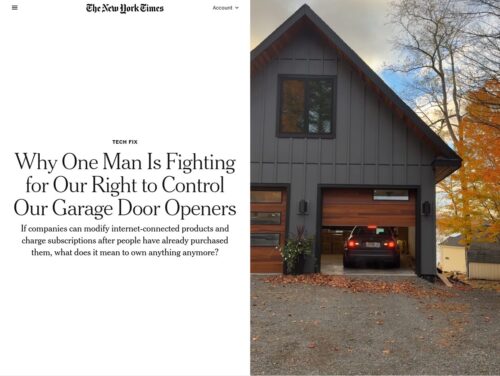
Captura de pantalla del reportaje "Why One Man Is Fighting for Our Right to Control Our Garage Door Openers"

If companies can modify internet-connected products and charge subscriptions after people have already purchased them, what does it mean to own anything anymore?

…Chamberlain started shutting down support for most third-party access to its MyQ servers. The company said it was trying to improve the reliability of its products. But this effectively broke connections that people had set up to work with Apple’s Home app or Google’s Home app, among others. Chamberlain also started working with partners that charge subscriptions for their services, though a basic app to control garage doors was still free.

While Mr. Wieland said RATGDO sales spiked after Chamberlain made those changes, he believes the popularity of his device is about more than just opening and closing a garage. It stems from widespread frustration with companies that sell internet-connected hardware that they eventually change or use to nickel-and-dime customers with subscription fees.

Too often, we are losing control of our personal technology, and the list of examples keeps growing. BMW made headlines in 2022 when it began charging subscriptions to use heated seats in some cars — a decision it reversed after a backlash. In 2021, Oura, the maker of a $350 sleep-tracking device, angered customers when it began charging a $6 monthly fee for users to get deeper analysis of their sleep. (Oura is still charging the fee.)

For years, some printer companies have required consumers to buy proprietary ink cartridges, but more recently they began employing more aggressive tactics, like remotely bricking a printer when a payment is missed for an ink subscription.

The activists and tinkerers rebelling against superfluous hardware subscriptions and fighting for device ownership are part of the broader “right to repair” movement, a consumer advocacy campaign that has focused on passing laws nationwide that require tech and appliance manufacturers to provide the tools, instructions and parts necessary for anyone to fix products, from smartphones to refrigerators.

In a perfect world, consumers would be able to load whatever software they wanted onto the hardware they owned. But the Digital Millennium Copyright Act, introduced in the 1990s to combat content piracy, made it potentially criminal to circumvent digital locks that companies embed into copyrighted software. That’s why we generally don’t see tinkerers publish tools that remove subscription requirements from heated car seats, sleep-tracking devices and printers, said Nathan Proctor, a director at U.S. PIRG, a consumer advocacy nonprofit.

Kyle Wiens, the chief executive of iFixit, a company that sells repair parts, offered this rule of thumb: Always opt for the “dumb” devices — the refrigerators, dishwashers, exercise bikes and coffee makers that lack a Wi-Fi connection or screen.

“That smart fridge would make your life worse in every way,” Mr. Wiens said.

L’envie de faire cet épisode aurait pu naître de la gigantesque panne informatique la plus massive de l’histoire, dit-on, qui a eu lieu avant l’été, donc ces milliers d’ordinateurs qui sont tombés en rade à cause d’un bug survenu après la mise à jour d’un logiciel de sécurité. Ça aurait pu être ça, mais non, en fait tout part d’une coïncidence beaucoup plus anecdotique.

Apoyamos a organizaciones y colectivas en el uso de tecnologías libres, licencias, y cultura libre, desde una perspectiva emancipadora y de género en América Latina.

Infraestructura basada en software libre y datacenters neutrales con alta disponibilidad de ancho de banda y hardware, en un entorno confiable, seguro y respetuoso orientado al uso de organizaciones de derechos humanos, movimientos sociales, instituciones, colectivos, ongs y medios comunitarios.

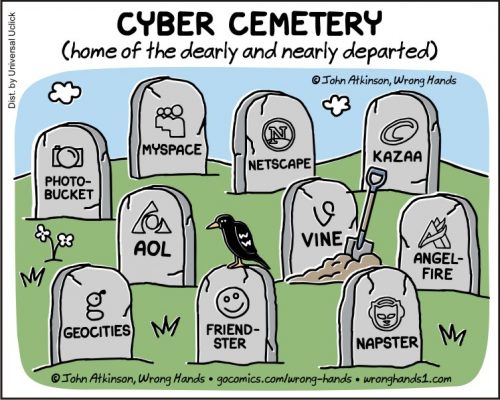
cyber cemetery

Site deaths are when sites go offline, taking content and permalinks with them, and breaking the web accordingly. Site deaths are one of the big reasons why you should own your own identity and content on the web.

This is a chronology of content hosting sites that have died, removing millions (billions?) of permalinks from the web. This is specifically for content hosting sites which permitted end-user posting. Not random sites nor pure «app» sites where there’s no loss of user data. If a game site goes down and takes down play history/scores, or if Gmail went away those would both represent loss of user data (though no public permalinks).

Purism ha desarrollado su propia distribución PureOS, que es un derivado de Debian, que no contiene binarios propietarios y es muy enfocado en seguridad. Purism también trata de upstream su código para que Debian y otras distros puedan aprovechar de sus mejoras. El plan de Purism es posibilitar Linux como una plataforma móvil para que otras empresas también puedan crear celulares y tabletas de Linux.

el Librem 5 será hardware libre y será posible imprimir sus partes plásticos con una impresora de 3D y fabricar su PCB (placa de circuitos).

El Librem 5 es diseñado para luchar en contra de la colección y comercialización de los datos de usuarios, que es el plan de negocios de Google, Facebook, Amazon, Tencent y ahora Microsoft. Esta tendencia maliciosa está aumentando con más uso de los redes sociales del web y la necesidad de entrenar las inteligencias artificiales (AI) con muchos datos de usuarios. La competencia para obtener la mejor AI esta impulsando la recolección de datos personales.

Además Purism esta creando una plataforma llamada “Liberty” para ofrecer servicios web por un precio fijo mensual, para evitar servicios web como los de Google, Facebook, Twitter, Microsoft, etc., que son “gratis”, pero son basados en la comercialización de los datos de usuarios.

Aproximadamente 80% de toda la energía de un aparato móvil es consumido durante su fabricación inicial. Un celular que dura 1,5 años consumirá dos veces más energía por día que un celular que dura 3,3 años, si la energía de fabricación es incluida en el cálculo.

El Librem 5 tendrá una batería removible y una ranura MicroSD para aumentar su memoria. Utilizará una ranura M.2 para conectar a un modem celular que significa que el modem podrá ser cambiado para soportar bandas de otras regiones y las bandas del futuro.

Purism fue fundado como un California Social Purpose Corporation. A diferencia que una organismo sin fines de lucro, Purism puede tener ganancias con tal que no interfieren en su obligación legal de cumplir con el siguiente propósito:

The Corporation shall be devoted to ensuring the security, privacy, and freedom of the users of its products, and the hardware and software offered by Purism shall conform to the philosophy of the Free Software movement.

Sus estatutos incluyen la obligación de publicar todo el código escrito por Purism bajo un “free software license” y todos sus esquemas de hardware bajo un “free hardware license”.

Para promover una industria más ética que respeta los derechos digitales de usuarios, es necesario tener empresas como Purism que pueden impulsar el uso de software libre por toda la cadena de suministro.

No abrimos el procesador de texto, sino “word”. No pedimos que nos manden una hoja de cálculo sino un “excel”. Ya no buscamos en Internet, sólo “googleamos”. Y cuando modificamos una foto estamos “phothosopeando”.

Las palabras son fundamentales a la hora de construir la realidad. Comenzar a nombrar las cosas adecuadamente es el principio para concebirlas de forma distinta. Algo que parece obvio en temas de género donde asumimos la necesidad de utilizar un lenguaje inclusivo para visibilizara a las doctoras y juezas, nos cuesta aún en los temas tecnológicos.

Con la eficiente estrategia de “regalar” licencias educativas los sistemas privativos se fueron enquistando en las computadoras de colegios y universidades. Los alumnos y alumnas consumen esa primera dosis de software privativo y quedan enganchados para siempre.

Aún hay quienes opinan que instalar software ilegal (“pirata”) en sus computadoras es una forma de resistencia contra el monopolio privativo del software. Pero de seguro nunca incentivarían la siembra de semillas transgénicas aunque no hubieran tenido que pagar por ellas.