
Why One Man Is Fighting for Our Right to Control Our Garage Door Openers

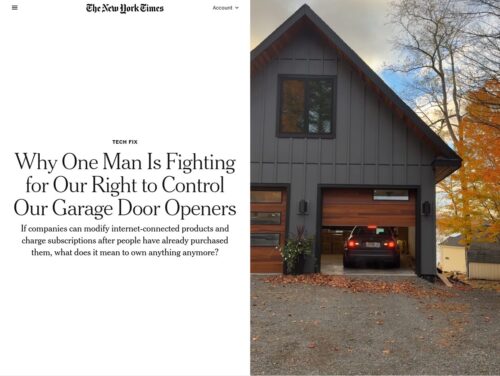
If companies can modify internet-connected products and charge subscriptions after people have already purchased them, what does it mean to own anything anymore?
…Chamberlain started shutting down support for most third-party access to its MyQ servers. The company said it was trying to improve the reliability of its products. But this effectively broke connections that people had set up to work with Apple’s Home app or Google’s Home app, among others. Chamberlain also started working with partners that charge subscriptions for their services, though a basic app to control garage doors was still free.
While Mr. Wieland said RATGDO sales spiked after Chamberlain made those changes, he believes the popularity of his device is about more than just opening and closing a garage. It stems from widespread frustration with companies that sell internet-connected hardware that they eventually change or use to nickel-and-dime customers with subscription fees.
Too often, we are losing control of our personal technology, and the list of examples keeps growing. BMW made headlines in 2022 when it began charging subscriptions to use heated seats in some cars — a decision it reversed after a backlash. In 2021, Oura, the maker of a $350 sleep-tracking device, angered customers when it began charging a $6 monthly fee for users to get deeper analysis of their sleep. (Oura is still charging the fee.)
For years, some printer companies have required consumers to buy proprietary ink cartridges, but more recently they began employing more aggressive tactics, like remotely bricking a printer when a payment is missed for an ink subscription.
The activists and tinkerers rebelling against superfluous hardware subscriptions and fighting for device ownership are part of the broader “right to repair” movement, a consumer advocacy campaign that has focused on passing laws nationwide that require tech and appliance manufacturers to provide the tools, instructions and parts necessary for anyone to fix products, from smartphones to refrigerators.
In a perfect world, consumers would be able to load whatever software they wanted onto the hardware they owned. But the Digital Millennium Copyright Act, introduced in the 1990s to combat content piracy, made it potentially criminal to circumvent digital locks that companies embed into copyrighted software. That’s why we generally don’t see tinkerers publish tools that remove subscription requirements from heated car seats, sleep-tracking devices and printers, said Nathan Proctor, a director at U.S. PIRG, a consumer advocacy nonprofit.
Kyle Wiens, the chief executive of iFixit, a company that sells repair parts, offered this rule of thumb: Always opt for the “dumb” devices — the refrigerators, dishwashers, exercise bikes and coffee makers that lack a Wi-Fi connection or screen.
“That smart fridge would make your life worse in every way,” Mr. Wiens said.